
Progress Invoice Guide: Milestone and Percentage Billing
Learn how progress invoices work for staged projects, how they differ from deposits and final invoices, and how to bill percentages or milestones cleanly.
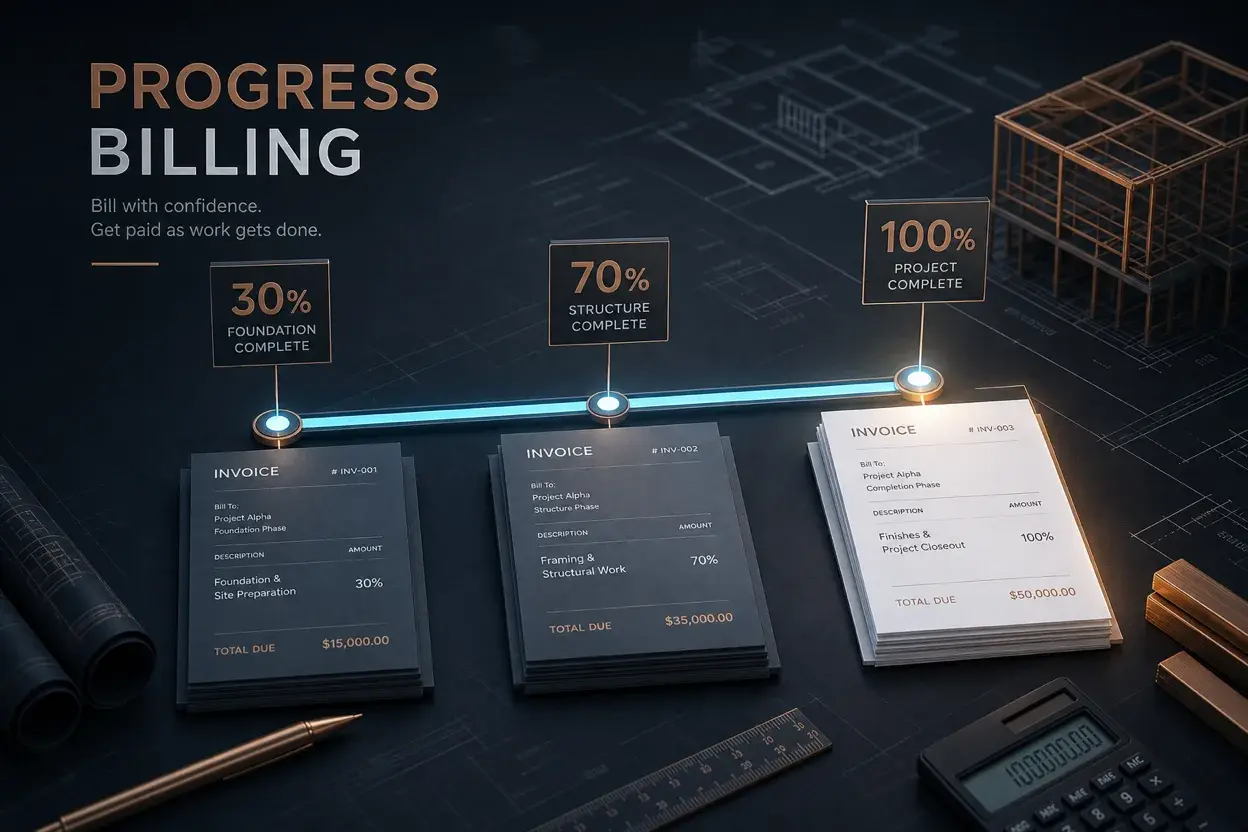
A kitchen remodel, office build-out, or phased software implementation rarely belongs on one invoice at the end. You need cash while materials and labor land—and the client needs proof that each payment matches work actually done.
A progress invoice (progress billing invoice) requests payment for a portion of a larger contract based on work completed, a milestone reached, or a scheduled percentage of the total price. It is a normal payable invoice—not a quote—usually one in a series ending with a final invoice for the last balance.
This guide is for contractors, trades, and project-based businesses that bill in stages. Rules for tax invoices, retainage, and prompt payment vary widely by jurisdiction and contract type. The sections below are operational guidance, not legal advice. When amounts are large or a public agency is involved, read your contract and local rules before withholding or releasing funds.
Progress billing vs deposit vs final invoice
These three documents solve different cash-flow problems. Mixing the labels creates disputes in accounts payable.
| Document | Typical timing | What it bills | Common label mistake |
|---|---|---|---|
| Deposit invoice | Before or at kickoff | Upfront portion to start work | Calling it 'progress' when nothing is yet delivered |
| Progress invoice | During the job | Agreed % or milestone after partial completion | Billing the full contract total each time |
| Final invoice | Substantial completion or punch list | Remaining balance, less prior payments | Forgetting to credit earlier progress payments |
A deposit secures commitment before full performance. See the deposit and down payment guide for 50% upfront patterns and balance invoices.
A progress invoice assumes work is underway and bills only the stage due now.
A final invoice closes the contract. It should show the contract total, sum of progress payments received, and the balance due—often after punch-list items are accepted.
Australian Government invoice guidance applies to each payable document: clear description, amounts, payment instructions, and a unique invoice number. Payment terms guidance also notes that installment timing should appear in the contract and on the invoice so customers know when each stage is due.
Two ways to set progress amounts
Percentage of contract value
The schedule is written as shares of one total price—for example 30% / 40% / 30%. Each progress invoice states the percentage, the contract reference, and the dollar amount due now.
Best when: the scope is fixed, the client wants predictable draws, and both sides agree on what each percentage represents.
Milestone-based billing
Each invoice ties to a defined event: foundation complete, rough-in inspected, cabinets installed, UAT signed off.
Best when: risk shifts at clear technical gates, or equal percentages would misalign with actual cost (early phases are material-heavy).
| Approach | Invoice line should name | Watch out for |
|---|---|---|
| 30/40/30 schedule | Draw 2 of 3 — 40% of contract $40,000 | Skipping draw numbers; client loses sequence |
| Milestone | Milestone: electrical rough-in complete, per §4.2 | Vague 'phase 2' with no definition |
| Cost-loaded schedule of values | Line items from approved schedule, period ending 30 Sep | Billing ahead of installed work |
| Time & materials cap | T&M through 15 Sep, not to exceed $8,200 | Exceeding cap without change order |
Whatever pattern you choose, put the same language in the signed contract/quote and on every progress invoice so the series reads as one story.
Retainage: an operational note
On many construction-style contracts, the payer withholds a portion of each progress payment—often called retainage or retention—until substantial completion or final acceptance. It is security for performance, not a discount.
Percentages and release timing depend on the contract and local law. U.S. federal construction contracting guidance (48 CFR § 32.103, summarized on Acquisition.GOV) discusses retainage on progress payments in a government context; state and local public works rules often set their own caps. Private commercial jobs follow whatever the parties negotiated.
Operational habits that reduce confusion:
- State on the invoice whether retainage was withheld and the net amount due now
- Track withheld amounts in your own ledger—even if you do not bill retainage release as a separate line until the contract says so
- Do not invent retainage on a small private job unless the contract requires it
- Release retainage only when your contract and acceptance criteria say you may—not because the calendar changed
This is not tax or legal advice. Ask a qualified adviser when retainage affects your books or lien rights.
A progress invoice for $4,000 gross with 10% retainage withheld is not the same as an invoice for $4,000 due in full. If retainage applies, show the math or the net due so the client’s AP team pays the correct amount.
Worked example: $40,000 job, 30/40/30
Contract: Bathroom renovation, fixed price $40,000.
Schedule: 30% at contract signing, 40% at rough-in complete, 30% at final completion.
Terms: Net 10 per draw.
Retainage: None on this private residential example.
Draw 1 — deposit / mobilization (30%)
Invoice INV-2201
- Description:
Bathroom renovation — Draw 1 of 3 (30% of $40,000 contract) - Item details:
Mobilization and demolition per quote BR-2026-07 - Amount due: $12,000
- Due date: on receipt (or within 7 days of signing)
Mark paid when the transfer clears before ordering custom tile.
Draw 2 — progress at rough-in (40%)
Invoice INV-2202
- Description:
Bathroom renovation — Draw 2 of 3 (40% of $40,000 contract) - Item details:
Rough-in complete 18 Sep 2026 · Plumbing and electrical inspected - Amount due: $16,000
- Notes:
Draw 1 INV-2201 ($12,000) received · Contract total $40,000
Send after the client (or inspector) signs off the milestone—not when materials are merely on site.
Draw 3 — final invoice (30%)
Invoice INV-2203
- Description:
Bathroom renovation — Draw 3 of 3 (final balance) - Item details:
Substantial completion 4 Oct 2026 · Punch list attached - Amount due: $12,000
- Notes:
Prior draws: INV-2201 $12,000, INV-2202 $16,000 · Contract total $40,000
Optional: list punch-list allowances as zero-dollar lines only if your client expects that detail; otherwise keep the final bill short and put punch-list scope in item details or an attachment reference.
Running total check: $12,000 + $16,000 + $12,000 = $40,000. Every progress invoice should make that reconciliation obvious.
What to put on each progress invoice
Include standard invoice fields plus project-specific context:
- Contract or quote reference and job address / site ID
- Draw number (
Draw 2 of 3) or milestone name - Percentage of contract, when using a % schedule
- Period or completion date for the work covered
- Amount due this invoice—not the full contract unless that draw is truly 100%
- Prior invoices paid and amounts (on later draws)
- PO number when the client requires it
- Photos, inspection sign-off, or lien waiver references only when your contract calls for them
Number draws sequentially in descriptions even when invoice numbers are global (INV-2201, INV-2202). AP teams search by project name; draw order prevents paying Draw 3 before Draw 2.
Common progress billing mistakes
Billing the full contract value every time
Each progress invoice should request only the current stage. The final invoice collects the remainder.
No paper trail between draws
Later invoices should reference paid draws by number and amount. Without that, clients re-check whether $16,000 was already sent.
Progress before the milestone is real
Billing rough-in before inspection—or before the contract defines rough-in—invites chargebacks and kills trust on the final draw.
Deposits labeled as progress
The first check is often a deposit. Call it that on the invoice if the contract does. Renaming it Progress 1 without agreement blurs what happens if the job stops early.
Ignoring change orders
Added scope needs a written change order and its own billing logic. Do not fold $6,000 of extras into Draw 2 without updating the contract total on the invoice notes.
Forgetting tax and registration rules
GST, VAT, and sales tax treatment follow your registration and the supply rules where you operate—not the draw label. business.gov.au distinguishes tax invoices from regular invoices for Australian businesses; mirror the correct type on every draw.
Templates and related guides
- Construction invoice template — phased job layout
- Contractor invoice template — draw lines and job reference fields
- Construction billing software guide - product fit, limitations, and handoffs
- Deposit and down payment guide — upfront cash before progress starts
- Invoice payment terms guide — Net 10, due on receipt, and due dates
NeatInvoice helps you issue separate invoices per draw with clear descriptions, amount paid on the final bill, and live client links. It does not process payments or enforce retainage rules—that stays in your contract and your bank account.
Frequently asked questions
What is a progress invoice?
Is a progress invoice the same as a deposit?
What is a progress billing invoice?
How do I show previous payments on the final invoice?
When should I use milestones instead of percentages?
What is retainage on a progress payment?
Can I send progress invoices without a signed contract?
Sources and related guidance
References used to support this page in . Rules and product details can change; check the linked source for current, jurisdiction-specific information.
- How to invoice by Australian Government
- Payment terms by Australian Government
- Progress payments under construction contracts by Acquisition.GOV