
Consulting Invoice Guide: What to Include and How to Bill
Build a clear consulting invoice for hourly, project, or retainer work, with line-item examples, expense and PO tips, and a worked billing example.
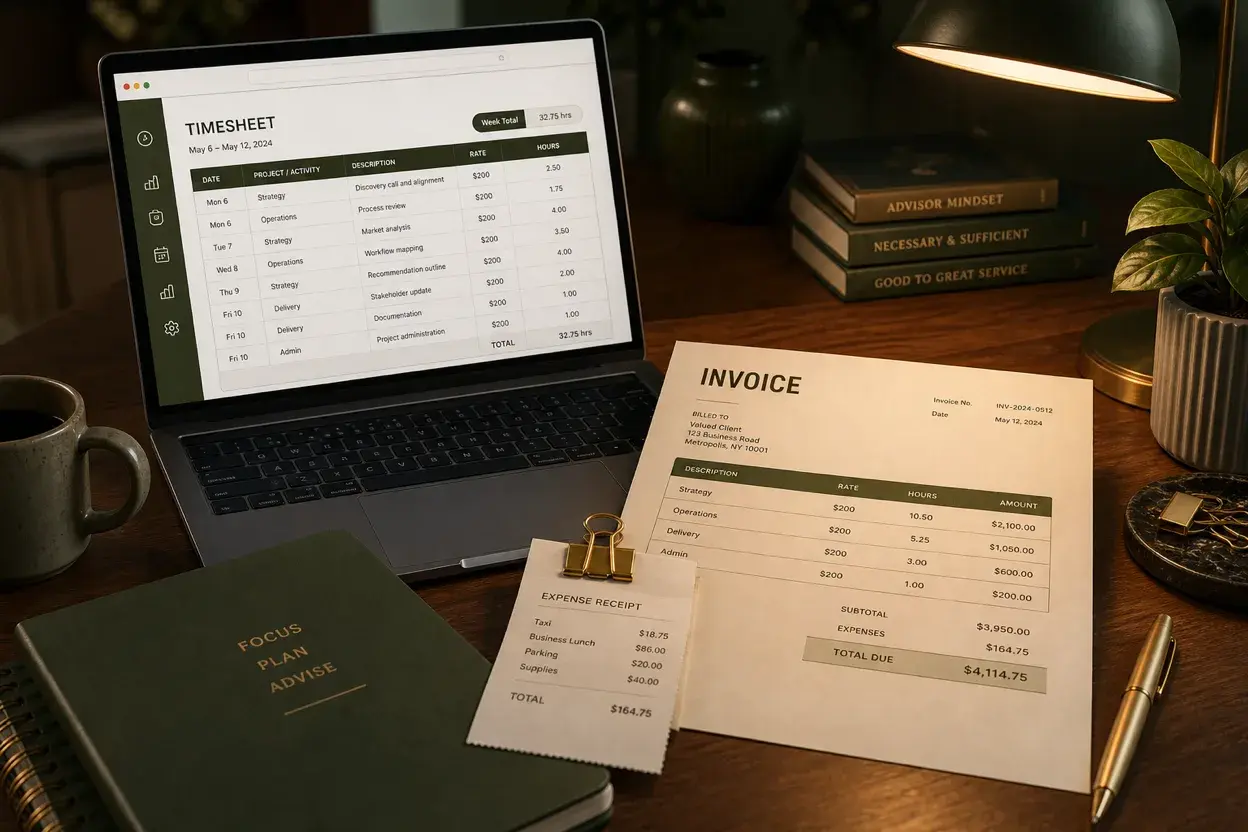
Your client approved the engagement. The work is underway. The invoice still needs to answer one question without a follow-up email: what did you deliver, for which period, and what does the client owe now?
A consulting invoice is a payment request for professional advice, analysis, or implementation work. It should name the service period or milestone, describe deliverables in plain language, show rates or fixed fees, list reimbursable expenses when they apply, and state when payment is due. Match the invoice pattern to how you sell: hourly, project-based, or retainer. For a larger engagement billed in stages, use a clear progress invoice sequence.
This guide is for independent consultants—strategy, operations, IT, HR, finance, marketing, and similar advisory work billed to a business client. Invoice and tax rules vary by country, registration, and client type. Treat the checklist below as operational guidance, not legal or tax advice.
What belongs on a consulting invoice
Australian Government invoice guidance lists practical fields most businesses include: your identity, a unique invoice number, issue date, description of services, amounts, and how you want to be paid. For consulting, add context that ties the bill to the engagement:
- Service period — the dates or sprint the charge covers (
September 1–30, 2026,Discovery phase,Sprint 3) - Deliverables — what the client received or what milestone was reached
- Rates and quantities — hours, days, or a fixed fee with a short scope reference
- Expenses — pass-through costs with receipts or a pre-agreed cap, labeled separately from your fee
- Purchase order (PO) — the client's PO number when their accounts payable requires it
- Payment terms and due date — plain language, not only
Net 30buried in email - Reference — statement of work, proposal, or contract ID
If you quoted before the engagement, the prepare quotes guide from business.gov.au is a useful mirror: itemized costs, payment terms, and clear scope belong on the quote and should reappear on the invoice in consistent language.
Three billing patterns consultants use
| Pattern | When it fits | What the invoice emphasizes |
|---|---|---|
| Hourly or daily | Scope shifts, advisory calls, staff augmentation | Period, hours or days, rate, brief activity summary |
| Fixed project | Defined outcome with agreed total fee | Milestone or phase name, % of contract, deliverable reference |
| Retainer | Ongoing access, capacity, or monthly deliverables | Service period, included scope, overage rule if any |
Hourly and daily billing
Bill the period you worked, not a vague project label. A weekly or biweekly cadence limits exposure and gives accounts payable a rhythm they can approve.
Example rhythm: 12.5 hours in September at $180/hour, due Net 15.
Fixed project and milestone billing
When the contract names phases, each invoice should map to one phase or one approved change order. Do not invoice the full contract value on every document unless that is truly what is due.
For upfront cash before kickoff, use a deposit invoice—not the same document as a progress or balance bill.
Retainer billing
A retainer bills an ongoing commitment: monthly capacity, a package of deliverables, or a prepaid hour bank. The invoice should state the service period and what is included. See the retainer invoice guide for scope, overage, unused hours, and when recurring generation is safe.
Clear line items vs vague ones
Accounts payable approves faster when each line answers what, when, and how much without opening the contract.
| Weak | Clear |
|---|---|
| Consulting services | Operations strategy consulting, September 2026 (18.0 hours @ $175/hr) |
| September work | HR policy review — Phase 1 discovery, per SOW-2026-14 |
| Expenses | Client workshop — venue deposit, receipt #8842 attached |
| Professional fees | CRM migration advisory — Milestone 2: data mapping sign-off |
| Services as per agreement | Fractional CFO support, Q3 month 1 (Aug 1–31) — includes 2 board prep sessions |
Use item details (the sub-line under the description) for proposal references, PO numbers tied to that row, or a one-line deliverable list. Keep document-wide terms—late payment policy, wire instructions—in invoice notes.
Expenses on the same invoice
Reimbursable expenses should be separate lines from your fee. Note whether they are billed at cost or with an agreed markup. Attach receipts when the client expects them. If expenses need pre-approval, say so on the invoice: Approved travel per email 12 Aug 2026.
Purchase orders
Some enterprise clients require a PO before payment. Ask during onboarding: "Do you need a PO on the invoice?" Put the PO on the invoice header or in notes so AP can match the bill to their internal record. The invoice vs purchase order guide explains which party issues each document and when. A missing PO can leave an invoice in an approval queue even when the amount is not disputed.
Worked example: hourly engagement with expenses
Engagement: IT security assessment for a regional retailer.
Rate: $195/hour.
Period billed: August 18–29, 2026.
Expenses: $340 workshop room (pre-approved).
Terms: Net 15.
Client PO: PO-44821.
Invoice INV-0312
| Line | Description | Qty | Rate | Amount |
|---|---|---|---|---|
| 1 | Security assessment — stakeholder interviews and risk register draft, Aug 18–29 | 22.0 hr | $195 | $4,290 |
| 2 | Workshop venue — receipt attached | 1 | $340 | $340 |
- Subtotal: $4,630
- Issue date: September 2, 2026
- Due date: September 17, 2026
- Notes:
PO-44821 · Per proposal IT-2026-08 · Expenses billed at cost
The client can approve the hours against the SOW without asking which week you meant. If August had included a fixed milestone instead, line 1 might read Milestone 1 — discovery complete, per SOW-2026-08 at a fixed $4,500 with no quantity column.
NeatInvoice does not process payments. You send the invoice and payment instructions; the client pays through your bank details or payment link. A 7-day trial on Solo or Studio does not mean a free workspace forever—see pricing when you need live links, reminders, and recurring billing.
Common consulting invoice mistakes
Billing a period the client cannot verify
Monthly consulting with no dates forces AP to email you. Always name the service period or milestone.
Mixing retainer hours with project fees on one line
Retainer overages and project change orders deserve separate lines or separate invoices so renewal discussions do not collide with close-out.
Forgetting the PO
If the client gave you a PO number, omitting it can delay payment longer than a rate dispute.
Expenses without context
A line that says only Travel invites rejection. State the trip purpose, date, and approval reference.
Invoicing before deliverables are defined
For fixed phases, send the invoice when the milestone is complete or explicitly billable per contract—not when you hope to finish by month end.
One invoice number reused for revisions
Issue a credit note or a new invoice when you correct a sent bill. Do not silently edit a document the client already received.
A simple monthly workflow
Close the period
Finalize hours, expenses, and deliverables
Draft
Match lines to SOW, PO, and period
Send
Issue with due date and payment instructions
Reconcile
Mark paid when funds arrive; note overages for next cycle
For payment term wording and due-date math, see the invoice payment terms guide. For duplicate numbers across clients, see the invoice numbering system guide.
Templates and a quick start
A consulting invoice template is just a reusable layout with the fields above already labeled. Start from:
- Freelance invoice template — hourly and project line layouts
- Independent contractor template — client PO and service-period fields
- Free invoice generator — draft a one-off bill without signing in
For software fit after the document is clear, see invoicing software for consultants.
Use the template that matches your engagement shape, then keep the same labels client to client so your records stay searchable.
Frequently asked questions
What is a consulting invoice?
Do I need a consulting invoice template?
How is a consulting invoice different from a retainer invoice?
Should I bill hourly or fixed fee on the invoice?
Do I need a separate line for expenses?
What if the client requires a purchase order?
Can I use one invoice for multiple months of work?
Sources and related guidance
References used to support this page in . Rules and product details can change; check the linked source for current, jurisdiction-specific information.
- How to invoice by Australian Government