
Construction billing
Construction billing software for straightforward projects
See how NeatInvoice handles estimates, progress invoices, change work, live links, reminders, and open balances for small construction teams.

Best fit
Best for owner-operated businesses with contract-led, reviewable billing.
NeatInvoice fits solo contractors and owner-operated construction businesses that need clear estimates, milestone or progress invoices, live client links, reminders, and an overview of outstanding balances. It is not construction accounting or project-control software. Businesses that need job costing, certified payroll, lien workflows, automated retainage, or AIA payment applications should use a specialist platform.
Written and reviewed by Willya Randika
Who does this construction billing workflow fit?
Construction billing becomes difficult when the invoice stops matching the contract record. A client may expect a deposit, a payment at each milestone, a percentage of work completed, or a formal payment application. Before choosing software, identify which document controls the amount, who approves it, and what evidence must travel with the request.
NeatInvoice is strongest when a solo contractor or small team can describe the approved work in a normal estimate and invoice. It keeps the document sequence clear without pretending to manage the construction project itself.
NeatInvoice publishes this guide. The fit test below names both the billing tasks it supports and the construction workflows that need specialist software.
NeatInvoice fits when
- You bill deposits, fixed milestones, time and materials, or simple progress amounts.
- The owner or project contact can approve a standard estimate and invoice.
- Change work is authorized outside the invoice, then referenced clearly when billed.
- You need live client links, PDF records, reminders, and a view of outstanding balances.
Use specialist software when
- The contract requires formal AIA payment applications, schedules of values, or certified forms.
- Retainage must be calculated automatically across many line items and releases.
- You need job costing, committed costs, purchase orders, certified payroll, or lien management.
- Several project roles must review drawings, submittals, field reports, and billing in one system.
The distinction is not about company size alone. A small specialty contractor can have a strict payment-application process, while a larger studio may run a few straightforward fit-out projects with ordinary milestone invoices. Use the contract and approval path as the test.
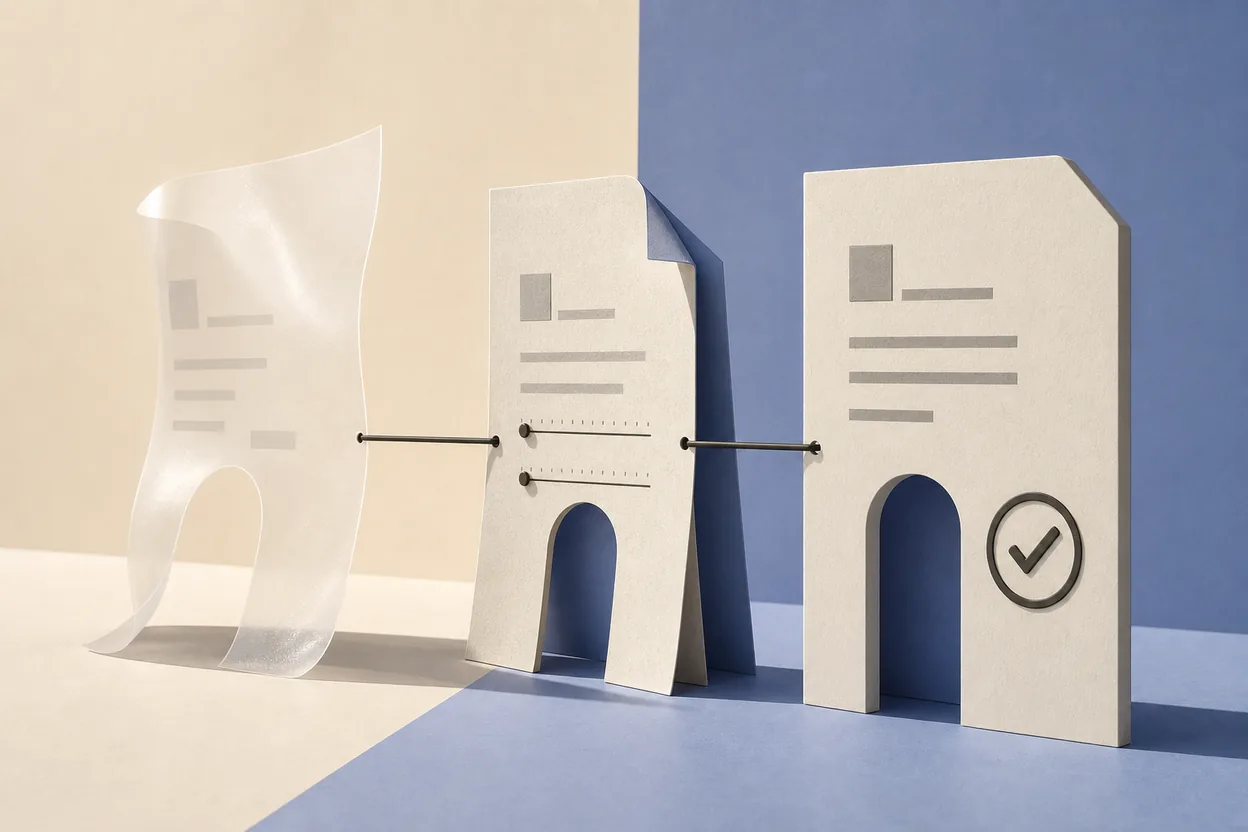
How should a small construction team move from estimate to payment?
Define the scope
Create an estimate with project address, included work, exclusions, price, and expiry.
Record acceptance
Keep the signed contract or written approval with the project record.
Bill the trigger
Convert the accepted estimate, then edit it for the deposit, phase, or current progress.
Share and review
Send the invoice through Share or provide a live link and PDF to the named reviewer.
Record payment
Mark the invoice paid only after funds arrive and keep the payment date.
An estimate is the commercial starting point, not proof that work was approved. NeatInvoice can convert an estimate into an invoice with one click, but the team must still confirm that the relevant milestone or percentage is billable. Review quantities, prior payments, change references, tax, and the due date before sharing.
Publishing an invoice creates a live link. It does not send the link, change the invoice to sent, or prove the client received it. Send through the Share flow or deliver the link through the agreed channel. A recorded view means the live page loaded. It does not establish acceptance of the work or the amount.
NeatInvoice does not process payments. Record payment status only after funds arrive through the provider or bank method agreed with the client.
Which NeatInvoice features map to construction billing tasks?
| Billing task | NeatInvoice support | Operating rule |
|---|---|---|
| Quote a project | Estimates with client-facing live links and PDF export | State scope, exclusions, project address, price, and expiry before work starts. |
| Request a deposit | Separate deposit invoice or a deposit line on the project record | Show what the deposit reserves and how it will be credited against later billing. |
| Bill a phase | Convert the estimate, then invoice the completed milestone | Name the contract milestone and approval trigger instead of using a vague progress label. |
| Bill approved changes | Additional line items and notes | Reference written authorization. The invoice should not be the first notice of extra cost. |
| Follow up | Email delivery, live-link views, reminders, and finance overview | Confirm the reviewer and blocker before escalating tone or timing. |
| Repeat a predictable charge | Recurring invoice blueprint | Use only for genuinely stable billing, such as a fixed monthly site service. |
The product stores invoice and estimate records, saved clients, reusable items, and business profiles. Studio supports multiple business workspaces when separate brands need their own sender identity. It does not store drawings, daily logs, subcontractor compliance, safety documents, or a construction ledger.
Worked example: a three-stage interior fit-out
The second invoice should not present the whole contract value as currently due. It can mention the contract total and prior deposit in notes, while the amount due remains tied to the second milestone. If the contract expects cumulative progress reporting, a standard invoice may not be enough. Use the required payment-application format instead of forcing that workflow into ordinary invoice rows.
Suppose the owner also approves a $1,250 lighting change. Keep the written change approval with the project record, then add a separate invoice line such as “Approved lighting change CO-04” with a useful description. Do not silently mix the extra into framing labor.
How should progress, prior payments, and retainage be shown?
Simple progress billing can work in a standard invoice when the contract permits it. State the billing period or milestone, work covered by the current request, prior payments that reduce the balance, and the amount requested now. The progress invoice guide explains milestone and percentage methods in more detail. Where the project starts with an upfront request, the deposit and down payment guide explains how to keep that payment distinct from later progress billing.
Retainage needs more caution. If a contract withholds a percentage until completion, show only what the agreement requires and make the current amount due unambiguous. NeatInvoice does not calculate retainage across a schedule of values, manage releases, or create AIA G702/G703 forms. AIA describes those documents as an application and certificate for payment with contract-sum and progress calculations, which is a different record from a normal invoice.
Do not label a NeatInvoice document as an AIA payment application or certified construction form. If the contract requires those records, prepare them in approved construction software or the official document workflow. Use NeatInvoice only for a separate invoice if the contract and reviewer expect one.
When are recurring invoices and reminders appropriate?
Recurring invoices fit predictable charges, not uncertain construction progress. A fixed monthly site-maintenance fee or equipment-storage charge may suit a recurring blueprint. A phase that depends on inspection, measured quantity, or owner approval should stay manual so someone reviews the evidence and amount before delivery.
For a stable charge, choose draft generation when a project manager should inspect each occurrence. Auto-send is safer only when client, amount, service period, due date, payment instructions, and recipient remain predictable. Pause the schedule when the contract changes or the underlying service stops.
Reminders also need context. An invoice may be waiting for a purchase-order reference, the correct approver, supporting documents, or resolution of a disputed change. Check delivery and approval status before escalating. NeatInvoice can show live-link views and overdue balances, but the operator decides whether a reminder is appropriate.
NeatInvoice vs construction software vs accounting software
| System | Best role | Important boundary |
|---|---|---|
| NeatInvoice | Focused estimate, invoice, live-link, reminder, and balance workflow | No job costing, schedule of values, retainage automation, lien workflow, or construction accounting. |
| Construction management platform | Project controls, field records, cost commitments, subcontractors, and formal billing | May be heavier than a solo contractor needs for straightforward client invoices. |
| Accounting suite | Ledger, bank reconciliation, expenses, financial reports, and tax records | May not offer the same lightweight client-link and follow-up workspace. |
These systems can coexist, but assign ownership. If construction software owns the contract value and progress calculation, do not independently calculate a conflicting amount in NeatInvoice. If accounting software owns the ledger, reconcile the final invoice and payment there according to your accountant's process.
Construction billing setup checklist
Before sending the first project invoice:
- Create or select the correct business profile and currency.
- Save the legal client and billing contact separately from the site address where needed.
- Confirm invoice-number sequence and any client purchase-order format.
- Create reusable items only for services or materials whose wording stays useful.
- Put scope, exclusions, and expiry on the estimate.
- Choose deposit, milestone, or simple progress billing from the contract.
- Record written change approval before billing extra work.
- Review tax treatment and required fields for the applicable jurisdiction.
- Decide who sends the live link or PDF and who monitors replies.
- Record payment only after funds arrive through the chosen payment method.
The paired construction invoice template shows a project address, phases, labor, materials, and change references. It does not claim to be an AIA form and leaves rates and tax blank.
Frequently asked questions
Is NeatInvoice full construction accounting software?
Can NeatInvoice create progress invoices?
Does NeatInvoice automate retainage?
Can a construction estimate become an invoice?
Does NeatInvoice process client payments?
Start with the construction invoice template
Load profession-specific line items into the free generator. Rates and tax stay blank so you can enter the terms agreed for the actual job.
- No sign-up
- No watermark
- PDF export
Explore by trade
Related industries

Contractor invoicing
Contractors
Best for contract-led work without dispatch or job-costing needs.

Electrical invoicing
Electricians
Best for clear billing after scope and approvals are managed elsewhere.

Landscaping invoicing
Landscapers
Best for project and recurring billing with lightweight operations.
Related articles
 Contractors
Progress Invoice Guide: Milestone and Percentage Billing
Learn how progress invoices work for staged projects, how they differ from deposits and final invoices, and how to bill percentages or milestones cleanly.
 Estimates
Quote vs Invoice vs Estimate: Key Differences (2026)
Compare quotes, estimates, and invoices by timing, commitment, revisions, acceptance, and payment purpose, with a practical project workflow.
 Deposits
How to Invoice a Deposit or Down Payment (2026)
Learn when to request a deposit, compare separate deposit and balance invoice patterns, and follow a practical $1,000 freelance project example.
Sources and related guidance
References used to support this page in . Rules and product details can change; check the linked source for current, jurisdiction-specific information.
- Invoices - what they must include by GOV.UK
- How to invoice by Australian Government
- Completing G702-1992, Application and Certificate for Payment by AIA Contract Documents