
Invoice vs Purchase Order: What’s the Difference?
Compare invoices and purchase orders by issuer, timing, purpose, matching workflow, and payment role, with a clear example for service businesses.
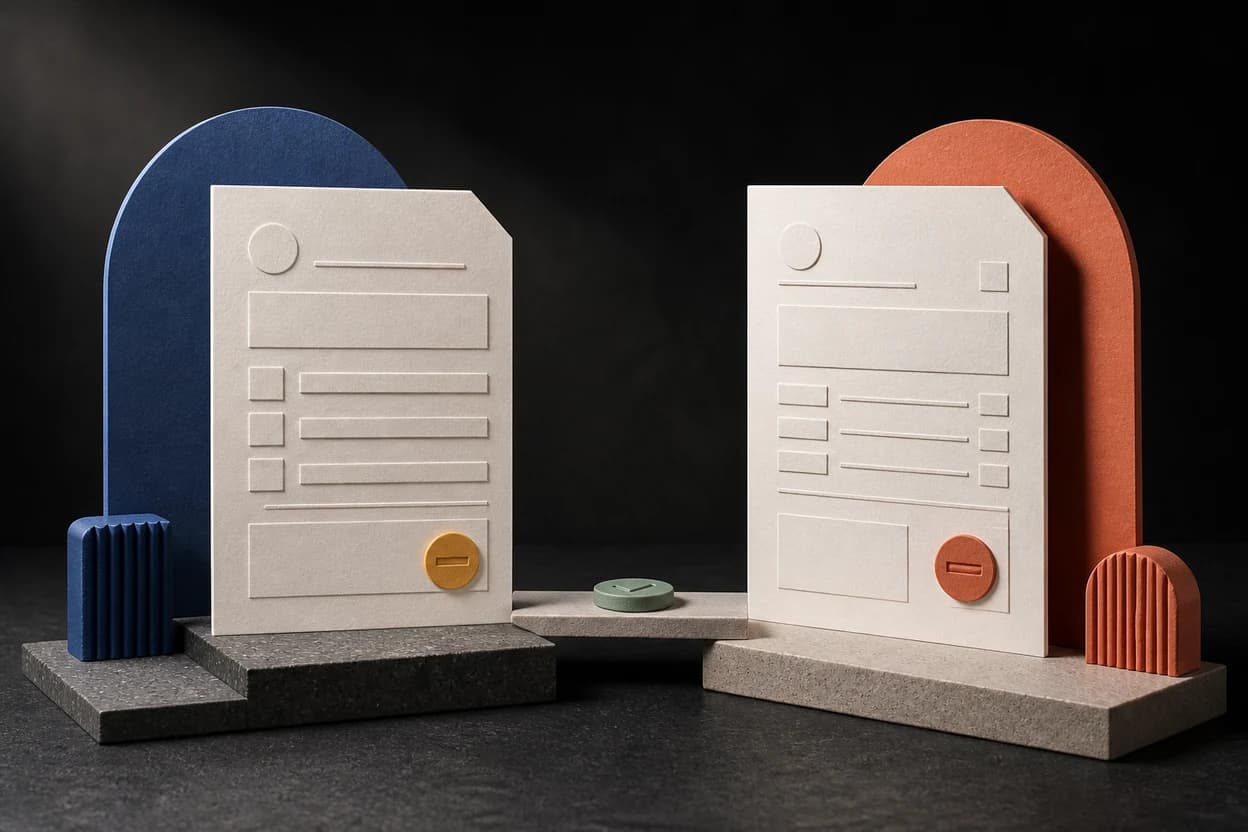
A purchase order authorizes a purchase. An invoice requests payment for what the seller supplied. They may contain similar names, quantities, prices, and references, but they are created by different parties at different points in the transaction.
The buyer issues a purchase order before delivery to define what it is ordering. The seller issues an invoice after delivery, a service period, or an agreed milestone to state what is now due. A PO is not proof of payment, and an invoice does not replace the buyer's approval process.
Invoice vs purchase order at a glance
| Question | Purchase order | Invoice |
|---|---|---|
| Who creates it? | Buyer or customer's procurement team | Seller, supplier, or contractor |
| When? | Before goods or services are supplied | After delivery, during a milestone, or when payment becomes due |
| Main purpose | Authorize and describe a purchase | Request payment for supplied goods or services |
| Key reference | PO number | Invoice number, often with PO number |
| Does it show money due now? | Usually shows authorized value, not an outstanding balance | Shows the amount and payment terms now due |
| Does it prove payment? | No | No; a paid record or receipt supports payment |
This is a practical distinction, not a universal rule for every contract or jurisdiction. A purchase order can become contractually significant when accepted, and public procurement has its own rules. For example, the US Federal Acquisition Regulation says federal purchase orders generally use fixed prices and specify the quantity or scope and required delivery date. Private-business processes may be much simpler.
How the documents fit together
Quote
Seller proposes scope and price
Purchase order
Buyer authorizes the purchase
Delivery
Goods or services are received
Invoice
Seller requests payment
Payment
Buyer settles the approved amount
Not every small-business transaction uses every document. A freelancer may work from a signed proposal and invoice without a PO. A larger client may reject the same invoice until its procurement team issues a PO number.
What a purchase order should contain
A purchase order commonly identifies:
- Buyer and supplier
- PO number and issue date
- Goods, services, quantities, or scope
- Agreed prices and currency
- Delivery date and location
- Billing or payment terms
- Buyer approval and applicable conditions
The buyer owns the PO sequence. The supplier should not invent a PO number or reuse an old one to get an invoice through accounts payable.
What an invoice should contain
An invoice commonly identifies:
- Seller and customer billing details
- Unique invoice number
- Invoice date and due date
- Delivered goods, service period, or milestone
- Quantities, rates, tax, and total
- Currency and payment instructions
- Customer PO number when required
The seller owns the invoice sequence. See the invoice numbering guide for formats, duplicates, and yearly resets. The sales invoice guide covers the seller's payable document in more detail.
Why accounts payable compares the PO and invoice
The buyer wants to confirm that the amount billed agrees with the purchase it authorized. A basic two-way match compares the PO and invoice. A three-way match also checks a receipt or evidence that the goods or services were accepted.
SAP's invoice reconciliation guidance explains that mismatches can lead to acceptance, correction, rejection, or manual review. The invoice reconciliation guide shows how to verify the supporting records and resolve a mismatch before changing the invoice status. In practice, an invoice may pause because:
- The PO number is missing or belongs to another project
- The invoiced quantity exceeds the order
- The rate differs from the approved rate
- Delivery has not been recorded
- Tax or shipping was not authorized
- The PO has already been fully invoiced
The seller should treat these as specific exceptions, not send the same invoice repeatedly without checking what blocked approval.
Worked example: a design project with a PO
A company accepts a proposal for a $6,000 brand audit, billed 50% at kickoff and 50% on delivery.
The client's procurement team creates PO-7842 for the full $6,000 scope. At kickoff, the designer sends:
- Invoice number:
INV-0318 - PO reference:
PO-7842 - Description:
Brand audit — kickoff installment, 50% - Amount due:
$3,000 - Terms:
Net 15
After final delivery, the designer sends INV-0341 for the remaining $3,000 and references the same PO. The two invoice numbers remain unique; the PO number connects both payment requests to one authorized purchase.
The designer should not put $6,000 due on each invoice. The PO shows the authorized contract value, while each invoice shows the installment currently payable.
Does a purchase order come before an invoice?
Usually, yes. The PO exists to authorize the purchase before the seller bills for it. But operational exceptions occur:
- Emergency work starts before procurement finishes the PO
- A recurring agreement uses a blanket PO for many invoices
- The buyer creates a retrospective PO to regularize an approved purchase
- The seller does not require POs, but a particular enterprise customer does
Do not assume a retrospective PO will be approved. Ask the customer before starting work: “Will accounts payable require a PO number on my invoice?” If yes, identify who creates it and whether the PO must exist before work begins.
Can an invoice be issued without a purchase order?
Yes, when the parties' agreement and the customer's process do not require one. Many freelancers and small businesses invoice against a signed quote, contract, email approval, or recurring agreement.
However, “no PO, no pay” policies are common in larger organizations. If the client told you a PO is required, omitting it may delay approval even when the work was delivered correctly.
Put the PO number in a dedicated reference or visible invoice note. Do not bury it in the email subject only; the PDF or live invoice may be routed separately from your message.
What if the PO and invoice do not match?
Do not change the invoice until you know which record is wrong.
- Compare scope, quantity, price, tax, and dates.
- Check approved change orders or extensions.
- Ask the buyer whether the PO needs amendment.
- Correct the invoice if the seller made the error.
- Preserve the original issued record and correction trail.
If the difference concerns whether the work was authorized or delivered, move it into a documented invoice dispute process instead of treating it as a clerical edit.
Purchase order vs invoice vs receipt
These documents answer three different questions:
- Purchase order: What did the buyer authorize?
- Invoice: What is the seller asking the buyer to pay?
- Receipt or paid record: What payment was received?
Read invoice vs receipt for the final distinction. A PO and invoice may both show $6,000, but neither proves that $6,000 reached the seller.
A pre-invoice PO checklist
Before billing a client that uses purchase orders, confirm:
- The PO number is active and belongs to the correct business entity.
- Your legal or trading name matches the approved supplier record.
- The invoice amount does not exceed the available PO value.
- Line descriptions follow the PO or accepted milestone language.
- The bill-to address and submission channel are correct.
- Any required receipt or approval has been completed.
- Your invoice number and due date remain clear.
Frequently asked questions
What is the difference between an invoice and a purchase order?
Does a purchase order come before an invoice?
Can you issue an invoice without a purchase order?
Is a purchase order proof of payment?
Can several invoices use the same purchase order?
What if the purchase order and invoice do not match?
Sources and related guidance
References used to support this page in . Rules and product details can change; check the linked source for current, jurisdiction-specific information.
- FAR 13.302-1 General by Acquisition.GOV
- Overview of Invoice Reconciliation by SAP Help Portal
- Reviewing the Order Details for an Invoice Reconciliation by SAP Help Portal