
Proforma Invoice vs Invoice: Key Differences (2026)
Learn what a proforma invoice is, when to use one, how it differs from a payable invoice, and what to send after a client accepts.
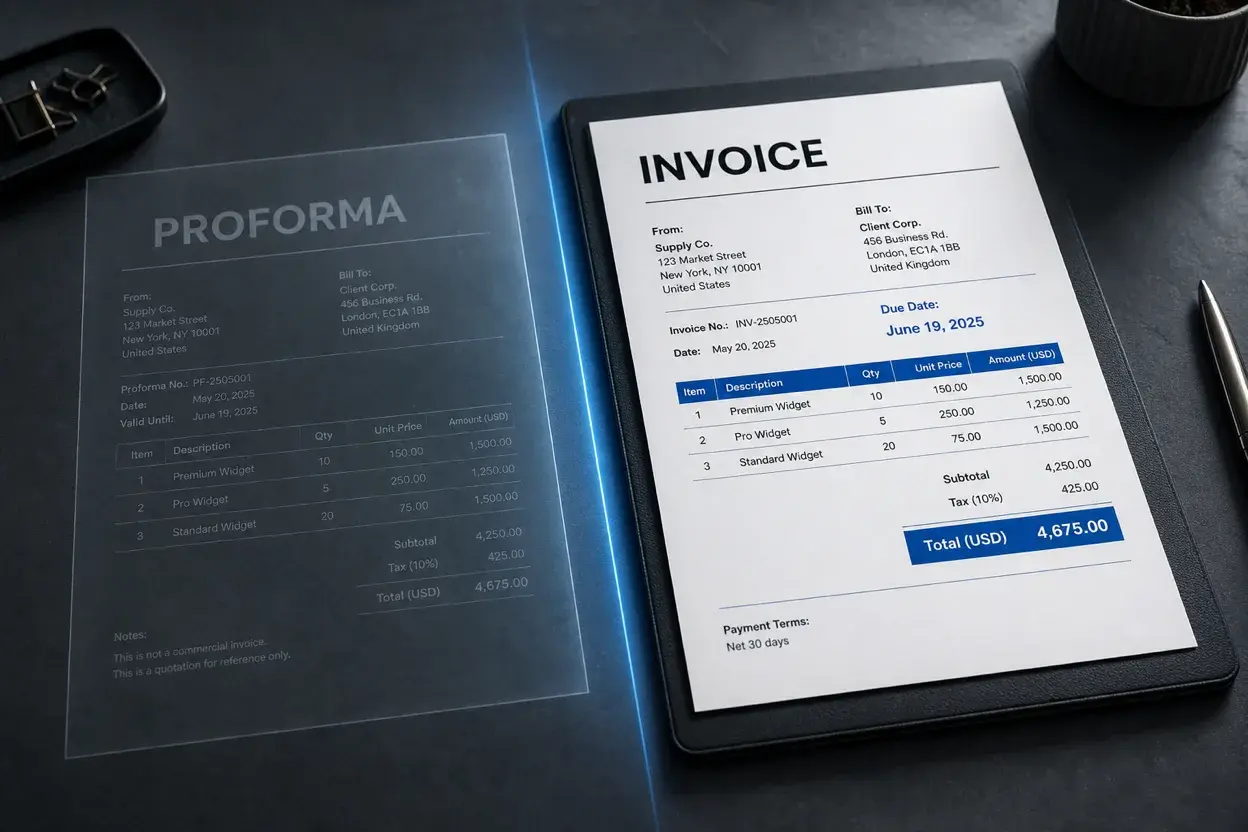
What is a proforma invoice? It looks like an invoice, but it is not the formal payment request you book as accounts receivable. Freelancers and exporters use it to show expected scope, price, and terms before work ships or before a commercial invoice is issued.
A proforma is a preliminary commercial document that describes a proposed sale. A standard invoice requests payment for an agreed supply. That is the core of proforma invoice vs invoice: preview versus payable request. Confusing the two creates awkward client conversations, weak bookkeeping, and—in some jurisdictions—VAT or tax evidence problems.
UK HMRC guidance describes these documents as commercial papers that can contain invoice-like information without fulfilling an invoice's primary function of formally confirming a supply. The U.S. International Trade Administration treats a pro forma invoice as a quotation prepared in invoice format, often used so a buyer can arrange import permissions, letters of credit, or funds.
Proforma vs invoice at a glance
| Question | Proforma | Invoice |
|---|---|---|
| Main purpose | Preview price, scope, and terms | Request payment for a supply |
| Typical timing | Before supply, shipment, or commitment | When payment is due for agreed work |
| Accounting role | Usually not a formal AR document | Starts accounts receivable |
| Client action | Review, budget, arrange funds, or approve | Pay, or dispute, the amount due |
| Tax evidence | Often insufficient as a tax invoice | May support tax records when rules are met |
| Best label | Clearly marked proforma / not a tax invoice | Invoice number and due date |
The visual similarity is the trap. If both documents use the same template, clients may treat the preview as payable and your bookkeeping may treat it as issued revenue before anything was supplied.
When this document is useful
Use a proforma when the buyer needs invoice-shaped detail before you are ready to issue a formal invoice:
- International buyers arranging import paperwork, letters of credit, or currency transfer
- New clients who need a detailed cost preview before approving work
- Projects that require an advance payment before you start, with a commercial invoice to follow after payment or delivery
- Situations where a quote feels too informal, but a payable invoice would be premature
For many domestic freelance jobs, a quote or estimate is enough. Choose a proforma when the buyer specifically asks for invoice format, or when cross-border process requires it.
What to include
Include enough detail for the buyer to approve or arrange funds, and mark the document clearly:
- Your business name and contact details
- Buyer name and billing details
- Explicit label such as “Proforma invoice”
- A note that it is not a tax invoice / VAT invoice, when relevant
- Description of goods or services
- Quantities, rates, currency, and totals
- Proposed payment terms and validity period for the offer
- Expected delivery or service window
- Shipping, Incoterms, weights, or origin details when the sale is physical goods for export
Keep numbering separate from your live invoice sequence when possible, or use a clear prefix such as PF-. That reduces the chance of treating a preview as an issued receivable.
Requirements for tax invoices and commercial invoices vary by country. Treat this as an operational checklist, not tax advice. If you are VAT-registered in the UK, HMRC guidance is that a proforma is not acceptable evidence for input tax and that a full VAT invoice should be issued when payment is received or a supply is made.
Proforma vs quote vs deposit invoice
These documents sit near each other, but they answer different questions.
A quote or estimate proposes price and scope. It does not need to look like an invoice.
A proforma is usually a quotation presented in invoice layout. Buyers often prefer it for banking and import processes.
A deposit invoice is a real payment request for an agreed upfront amount. It belongs in accounts receivable. See the deposit and down payment guide when the client has already approved the commercial terms and you need money before work starts.
Quote or proforma
Preview scope, price, and terms
Agreement
Client accepts the commercial offer
Deposit invoice
Request the agreed upfront payment
Final invoice
Request the remaining balance after delivery
A worked freelance example
A brand designer proposes a $4,800 identity package for an overseas client. The client’s bank asks for an invoice-format preview before releasing funds.
The designer sends PF-118, labeled “Proforma invoice — not a tax invoice,” valid for 14 days, with line items for discovery, logo system, and brand guidelines. No due date for payment is presented as a formal receivable; the document states that a commercial invoice will follow after acceptance.
When the client accepts, the designer issues invoice INV-2048 for a 40 percent deposit ($1,920), due on receipt. After delivery, invoice INV-2049 requests the remaining $2,880. The preview stays in the project folder as the document that unlocked approval. It is not marked paid, because it was never the payable document.
Common mistakes to avoid
Sending a preview that looks payable
If the only difference is the filename, clients will try to pay it and your records will drift. Mark it clearly and avoid a formal due-date tone unless you intend that document to collect payment.
Booking revenue too early
In normal circumstances, HMRC notes that a proforma is not an accounting document for the issuer or the recipient. Do not treat it as issued revenue until the commercial invoice and supply or payment rules in your jurisdiction say otherwise.
Reusing the same number later
If PF-118 later becomes INV-118, future searches get messy. Prefer distinct sequences.
Skipping the commercial invoice after payment
If payment arrives against a preview document, issue the proper invoice for accounting and tax records. Do not leave the proforma as the only document in the file.
Over-promising tax treatment
A proforma does not automatically satisfy tax-invoice rules. When tax evidence matters, follow the invoice rules for your registration and the buyer’s jurisdiction.
How to create one without confusing your live invoices
- Duplicate your normal invoice layout.
- Change the title to “Proforma invoice.”
- Add a short disclaimer that it is not a tax invoice, if applicable.
- Use a separate number prefix.
- State how long the offer remains valid.
- Omit or soften language that implies an already-issued receivable, unless that is truly your intent.
- After acceptance, create the real invoice for deposit or full payment.
You can draft the commercial invoice itself in the free invoice generator, then keep the preview as a clearly labeled document in the same project file set. Read the sales invoice guide for the fields and checks that belong on the payable document.
NeatInvoice helps you create and share professional invoices, including live client links on a trial or paid plan. It does not process payments, and it is not a substitute for jurisdiction-specific tax-invoice rules. Keep proforma previews separate from payable invoices in your records.
Frequently asked questions
What is a proforma invoice?
Is a proforma the same as an invoice?
Can a client pay against a proforma?
Is a proforma a tax invoice?
Do freelancers need one?
What should I send after it is accepted?
Sources and related guidance
References used to support this page in . Rules and product details can change; check the linked source for current, jurisdiction-specific information.
- Pro-forma invoices: Introduction by HMRC
- Pro-forma invoices: Can a pro-forma invoice be used to account for VAT? by HMRC
- Pro Forma Invoice by U.S. International Trade Administration