
Invoice vs Receipt: Differences and Examples (2026)
Learn when invoices and receipts are issued, what each document includes, how they support records, and when a paid invoice may not replace a receipt.
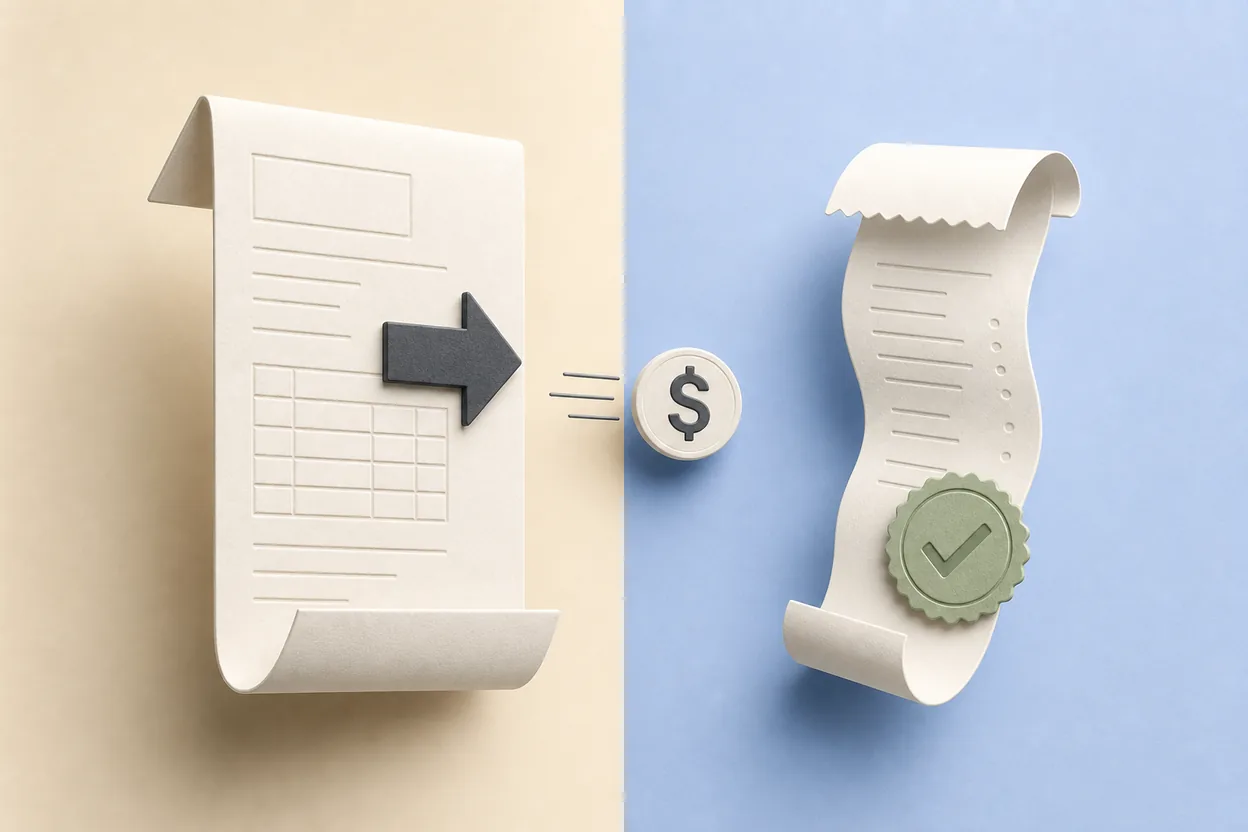
An invoice and a receipt can describe the same sale, but they do different jobs. Confusing them creates avoidable questions for clients, weakens your payment records, and can make reconciliation harder than it needs to be.
An invoice requests payment. A receipt confirms that payment happened. The invoice normally comes before payment and shows what is owed, when it is due, and how to pay. The receipt comes after payment and records what was paid, when, and by which method.
The distinction is also reflected in official guidance. The Australian Government's invoicing guide describes an invoice as a request for payment and explains that invoices and receipts together document the payment process.
Invoice vs receipt at a glance
| Question | Invoice | Receipt |
|---|---|---|
| Main purpose | Request and document payment | Confirm payment was received |
| Typical timing | Before payment | After payment |
| Amount status | Due, partly paid, overdue, or paid | Paid |
| Usually sent by | Seller or service provider | Seller or payment processor |
| Useful to the buyer | Approval, payment, and accounts payable | Expense evidence and reconciliation |
| Useful to the seller | Accounts receivable and follow-up | Payment record and customer support |
The distinction is about the transaction stage, not the visual design. A beautifully formatted invoice is still not automatically a receipt. A receipt may be a short email, a point-of-sale slip, or a formal document linked to the original invoice.
Estimate
Expected scope and price before approval
Invoice
Formal request for payment
Payment
Money moves through the chosen rail
Receipt
Confirmation that payment was received
Where invoices and receipts fit in a client project
A typical freelance project starts with a conversation, then a proposal, quote, or estimate. Once the work or billing milestone is ready, the freelancer issues an invoice. The client approves and pays it. Finally, the freelancer or payment provider confirms the payment.
The sequence is not identical for every engagement. A deposit invoice may be issued before work begins. A monthly retainer may be invoiced at the start of each month. A card processor may create a receipt automatically seconds after payment. The underlying roles stay the same: one document establishes an amount due, while the other records that it was paid.
If you are still deciding which pre-payment document to use, see quote vs invoice vs estimate. For upfront project billing, the deposit invoice guide covers separate deposit and balance patterns.
When a payer sends one transfer for several open invoices, the remittance advice guide explains how to match the allocation. For the seller-side document that starts the request, see the sales invoice guide.
What an invoice should include
A professional invoice should make the commercial request unambiguous. Include:
- Your business name and contact details
- The client's name and billing details
- A unique invoice number
- An issue date and explicit due date
- A clear description of each service or product
- Quantity, rate, subtotal, tax, discount, and total where relevant
- Amount already paid and balance due, if applicable
- Currency and payment instructions
- Concise payment terms
Requirements vary by country, tax registration, client type, and transaction. Treat this list as an operational baseline, not legal or tax advice. Check the rules that apply to your business and your client's jurisdiction.
What a receipt should include
A useful receipt connects the payment to the original request. It commonly includes:
- Seller and buyer names
- Receipt or transaction reference
- Payment date
- Amount and currency received
- Payment method, without exposing sensitive credentials
- Description of what was paid for
- Original invoice number
- Any remaining balance
For partial payments, state both the amount received and the balance still due. That prevents a partial-payment receipt from being mistaken for confirmation that the entire invoice was settled.
Receipt obligations depend on the transaction and jurisdiction. For one concrete example, Australian Government guidance explains receipts and proof-of-purchase requirements; do not apply those thresholds outside Australia without checking local rules.
Is a paid invoice the same as a receipt?
Sometimes a paid invoice is sufficient evidence for routine record-keeping, especially when it clearly shows a zero balance, payment date, and transaction reference. But it is not universally equivalent to a receipt.
A paid invoice starts as a payment request and is later updated. A receipt is created specifically to confirm payment. A client, accountant, marketplace, insurer, or tax authority may prefer one format over the other. Payment processors also often issue their own receipt even when the invoice has been marked paid.
Use a paid invoice when:
- Both parties can see the payment date and zero balance
- Your accounting workflow treats the updated invoice as the payment record
- The client does not require a separate receipt
Issue or retain a separate receipt when:
- The client requests one
- A processor produced a transaction confirmation
- The payment was split across methods or dates
- Local record-keeping rules require a distinct proof of payment
- A reimbursement process specifically asks for a receipt
NeatInvoice records invoice status and payment details, but it does not process payments. A Stripe, PayPal, Wise, or bank payment may produce its own confirmation. Keep that confirmation with the invoice record.
Three practical examples
1. Fixed-price freelance project
A designer finishes a $1,500 brand package and sends invoice INV-2041, due in 14 days. The client pays by bank transfer. The designer marks the invoice paid, adds the payment date, and keeps the bank reference. If the client needs reimbursement evidence, the designer also sends a short receipt referencing INV-2041.
2. Monthly retainer
A consultant sends a $2,000 invoice on the first day of each month. The invoice requests payment for that month's agreed availability and deliverables. When payment arrives, the receipt confirms only that month's transaction. The next monthly invoice is a new request, not a continuation of the old receipt.
For predictable monthly work, a retainer invoice and recurring schedule can reduce repetitive setup.
3. Partial payment
A developer invoices $4,000 with 50 percent due at kickoff and 50 percent on delivery. The first $2,000 payment does not close the invoice. The confirmation should say:
- Payment received: $2,000
- Original invoice:
INV-3108 - Remaining balance: $2,000
- Final due date: the agreed delivery date
That record is more precise than simply stamping the invoice "paid."
Accounting and record-keeping
Invoices help track accounts receivable: money clients owe you. Receipts help reconcile cash received with bank or processor activity. Keep both documents, plus contracts, credit notes, and payment references, for the retention period required in your jurisdiction.
Do not edit a settled invoice in a way that erases the original commercial record. If a material correction is needed, ask your accountant whether a credit note, voided document, or replacement invoice is appropriate. The right approach depends on local rules.
The void invoice guide separates cancellation, deletion, credit notes, write-offs, and refunds.
A clean workflow for freelancers
- Create the invoice with a unique number and explicit due date.
- Share the PDF or publish a live client link.
- Treat publish and send as separate actions. Publishing makes the link available; it does not prove the client received it.
- Follow up based on delivery, due date, and payment status.
- Record the payment date and reference when funds clear.
- Provide a receipt or retain the processor confirmation when needed.
- Store the invoice and proof of payment together.
Use the invoice payment confirmation email guide when you need wording for full, partial, retainer, or unmatched payments.
You can create the payment request with the free invoice generator, then export a professional PDF without an account.
Special cases that change the paperwork
Cash payments
Cash has no bank feed or processor email, so the receipt matters more. Record the payment date, amount, currency, invoice number, and the person who received it. Give the client a copy and retain one with the invoice. Never write sensitive identity information that the transaction does not require.
Card and wallet payments
The processor usually creates a transaction confirmation. Keep its reference with the invoice, but do not copy the full card number into your own records. The invoice explains what the client bought; the processor record explains how and when the charge settled.
Refunds
A refund does not erase the original invoice or receipt. Preserve the original transaction, then create the correction required by your accounting process. That might be a refund receipt, credit note, or other document. The correct form varies by jurisdiction and tax treatment.
Cancelled work
If no payment was made, voiding or cancelling the invoice may be sufficient. If a deposit was already received, document what was earned, refunded, or retained under the agreement. Do not relabel the original payment record to hide the sequence.
The same distinction applies to rent: a rental invoice template requests payment for a stated period, while a rent receipt confirms what the tenant actually paid.
Tips and additional payments
When the client pays more than the invoice total, record the extra amount according to its purpose. A voluntary tip, reimbursement, and accidental overpayment are different accounting events. Confirm the client's intent instead of silently changing the original line items.
A simple record bundle
For each completed project, keep a small bundle:
- Accepted quote, estimate, or contract
- Issued invoice and any revisions
- Delivery or acceptance evidence
- Bank or processor transaction reference
- Receipt or paid-invoice confirmation
- Credit note or refund record, if any
This bundle lets you answer a future question without reconstructing the project from email. It also separates proof of the commercial request from proof that money moved.
Frequently asked questions
Is an invoice proof of payment?
Can I use an invoice as a receipt?
Should a receipt have an invoice number?
Does a receipt need its own number?
What happens after a partial payment?
Sources and related guidance
References used to support this page in . Rules and product details can change; check the linked source for current, jurisdiction-specific information.
- How to invoice by Australian Government
- Receipts and proof of purchase by Australian Government
- GST/HST records to keep by Canada Revenue Agency