
Quote vs Invoice vs Estimate: Key Differences (2026)
Compare quotes, estimates, and invoices by timing, commitment, revisions, acceptance, and payment purpose, with a practical project workflow.
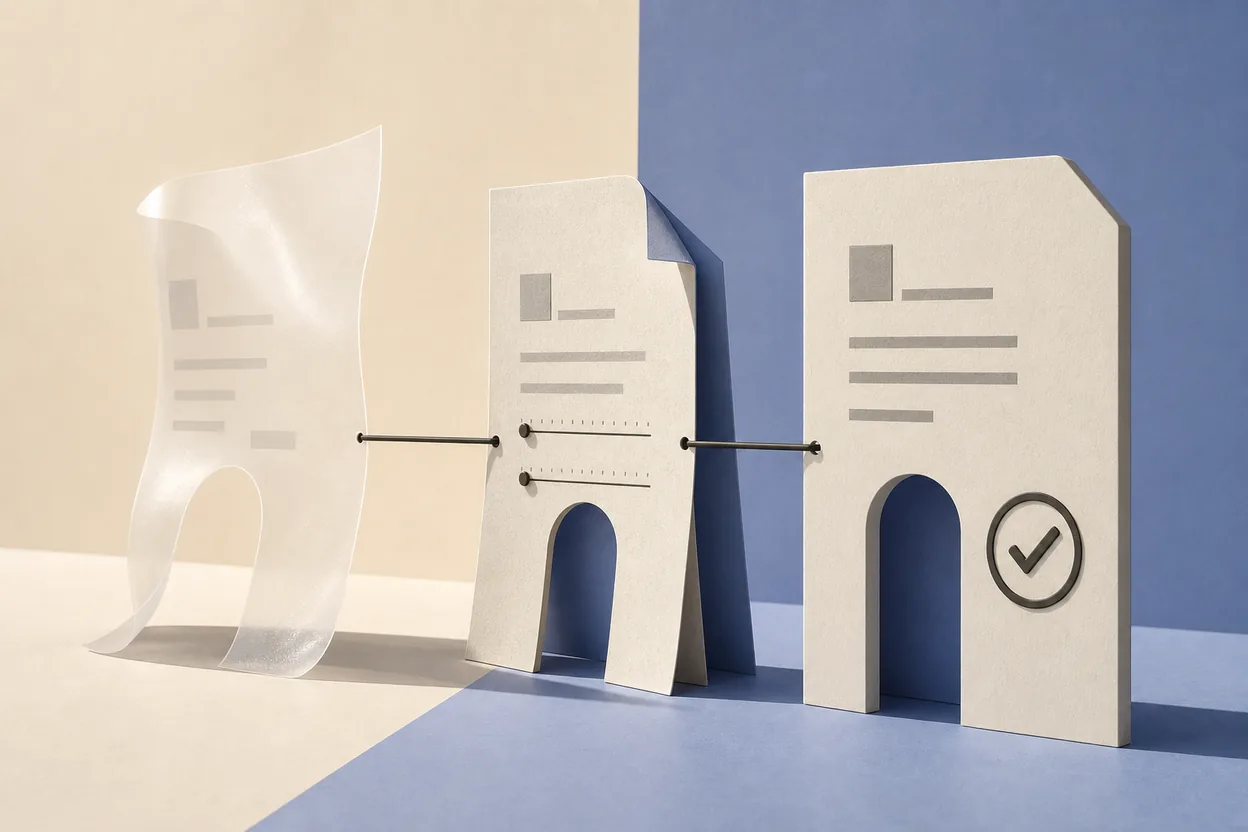
Quote, estimate, and invoice are often used as if they mean the same thing. They do not. Choosing the right document sets expectations before work begins and prevents a client from treating an early price range as a final bill.
A quote offers a defined price for defined scope, an estimate predicts a likely cost that may change, and an invoice requests payment. Quotes and estimates support a buying decision. An invoice records the amount now due after an agreement, milestone, or delivery.
Quote vs invoice vs estimate
| Document | When it appears | What it communicates | Typical next step |
|---|---|---|---|
| Quote | Before approval | A specific offer, scope, price, and validity period | Accept, decline, or revise |
| Estimate | Before approval | An expected cost based on current information | Clarify scope, approve, or revise |
| Invoice | At a billing milestone | A formal amount due and payment instructions | Pay, dispute, or reconcile |
The names are not perfectly standardized across countries and industries. Some businesses call every pre-sale document a quote; others use proposal, bid, or estimate. Define the document's role in plain language rather than relying on its label alone.
Draft
Prepare scope, assumptions, and price
Sent
Share a quote or estimate for review
Accepted
Capture the client's decision and agreed version
Converted
Create the invoice when billing is due
What is a quote?
A quote is a specific commercial offer. It usually describes the deliverables, price, taxes, exclusions, timeline, payment schedule, and an expiration date. A quote works best when scope is known well enough to commit to a price.
Useful quote wording includes:
Valid for 14 daysIncludes two revision roundsAdditional pages billed at $250 each50 percent due before kickoffDelivery within 15 business days after content approval
An expiration date protects both parties from treating an old price as permanently available. It also gives the client a clear action window.
What is an estimate?
An estimate is a good-faith projection based on information available now. It suits work where time, materials, discovery, or technical complexity can change the final amount.
An estimate should not be vague. State:
- The assumptions behind the range
- What could change the amount
- Which expenses are excluded
- When you will notify the client about a material variance
- Whether approval is required before exceeding a threshold
For example: Estimated 20 to 26 hours at $120/hour. Written approval required before work exceeds 26 hours. That is far clearer than a single estimated total with no boundary.
What is an invoice?
An invoice is a payment request. It should refer to the accepted scope, completed milestone, retainer period, or deposit agreement. It also needs a unique invoice number, issue date, due date, currency, line items, total, and payment instructions.
Do not send an invoice merely to communicate a possible price. That skips the approval stage and can make a client feel billed before they agreed. Use a quote or estimate first, then invoice the approved deposit, milestone, or final amount.
If the buyer specifically needs preliminary pricing in invoice format, use a clearly labeled proforma invoice rather than presenting it as an amount already due.
Is a quote or estimate legally binding?
It can be, depending on the wording, acceptance process, surrounding contract, and local law. A signed or clearly accepted quote may become part of a contract. An estimate may remain non-binding, but calling a document an "estimate" does not automatically remove every obligation.
For example, Australian Government quote guidance says an accepted quote can become a legally binding contract in Australia. That is a jurisdiction-specific example, not a universal rule.
Use jurisdiction-neutral operational safeguards:
- Label the document clearly
- State whether the price is fixed or estimated
- Define scope, assumptions, exclusions, and validity
- Record acceptance and the accepted version
- Put change approvals in writing
- Use a contract for material engagements
This guide is general business information, not legal advice. Ask a qualified local professional about enforceability, consumer rules, tax, and required disclosures.
Converting an estimate to an invoice
Conversion should preserve the source information without pretending nothing changed. A reliable workflow is:
- Keep the accepted estimate as a historical record.
- Create a new invoice from that accepted version.
- Carry over client details, line items, currency, tax, and notes.
- Add the invoice number, issue date, due date, and payment instructions.
- Update quantities or rates only when the client approved the change.
- Reference the estimate number on the invoice.
In NeatInvoice, an estimate can be shared as a live link for accept or decline, then converted to an invoice in one action. The conversion creates an invoice record and opens it so you can review the final payment request. The accepted estimate remains the pre-payment source of truth.
For trade-specific handoffs, compare the focused workflows in the service-business invoicing guides. They explain when estimate conversion is enough and when work orders, dispatch, compliance, or job-cost records require specialist software.
Conversion should save retyping, not skip review. Confirm the billing milestone, due date, tax, and final amount before sharing the invoice.
Worked example: a website redesign
A designer expects a five-page redesign to cost $4,800, but the client's content and integrations are not final.
Estimate stage
The designer sends EST-082:
- UX and visual design: 24 to 30 hours
- Front-end implementation: 30 to 38 hours
- Estimated range: $4,320 to $5,440
- Assumption: client provides approved copy
- Change rule: written approval before exceeding $5,440
After discovery, the team agrees on exact scope.
Quote stage
The designer replaces uncertainty with quote QUO-083:
- Five responsive pages
- One newsletter integration
- Two revision rounds
- Fixed fee: $5,100
- Valid for 14 days
- 40 percent deposit, 60 percent on delivery
The client accepts in writing.
Invoice stage
The designer sends a $2,040 deposit invoice linked to the accepted quote. The final $3,060 balance invoice is issued at delivery. Each invoice has its own due date and payment status.
This flow is more defensible than converting the first rough estimate directly into a $5,100 bill without recording the agreed change.
Common mistakes
Sending an invoice too early
An invoice is not a substitute for a proposal. If the client has not approved scope or the billing event, send the appropriate pre-payment document first.
Writing an estimate without assumptions
A number alone appears more certain than it is. Explain the variables and the approval threshold.
Issuing a quote without an expiry
Costs, availability, and delivery windows change. Add a reasonable validity period.
Overwriting the accepted version
Keep the version the client accepted. Create a revision or conversion record instead of silently changing the original.
Forgetting the deposit schedule
If the quote says 40 percent upfront, the first invoice should match it. The deposit invoice guide shows two clean ways to record the balance.
Which document should you send?
| Situation | Best starting document | Reason |
|---|---|---|
| Known deliverables and fixed price | Quote | You can make a specific offer |
| Discovery-heavy or variable hours | Estimate | The final cost depends on assumptions |
| Approved kickoff deposit | Invoice | A defined payment is now due |
| Completed milestone | Invoice | The contract triggers billing |
| Client asks for proof they paid | Receipt | It confirms payment rather than requests it |
See invoice vs receipt for the document that comes after payment, and the freelancer invoice guide for a complete invoice checklist.
Revisions and acceptance history
A pre-payment document is useful only if both parties can identify the accepted version. Add a revision marker or new document number when scope, price, or timing changes materially.
A practical history might look like:
EST-082 v1: initial range before discoveryEST-082 v2: revised integration assumptionsQUO-083: fixed offer after discoveryINV-1214: deposit invoice created from accepted quote
Record the date, recipient, and acceptance method. Acceptance may happen through a signed document, live-link response, email, or another method permitted by the agreement. Do not rely on a private note that the client cannot verify.
What should carry into the invoice?
Carry only approved commercial details:
- Client identity and billing address
- Currency and tax treatment
- Accepted line items
- Agreed deposit or milestone amount
- Purchase order and project reference
- Payment terms
Replace pre-sale fields with invoice fields. A quote expiry is not an invoice due date. An estimated range is not a final total. A proposal acceptance note is not a payment instruction.
What should stay with the source document?
Keep discovery assumptions, optional alternatives, and rejected revisions with the estimate or quote. Copying every pre-sale note into the invoice can make the payment request harder to read.
A decision checklist before conversion
Before selecting Convert to invoice, ask:
- Did the client accept this exact version?
- Is the billing milestone now due?
- Did scope, price, or tax change after acceptance?
- Should this be a deposit, progress invoice, or final invoice?
- Does the client require a purchase order?
- Is the payment recipient correct?
- Is the due date calculated from the agreement?
If any answer is unclear, pause conversion and resolve it. One-click conversion is an administrative shortcut, not commercial approval.
Naming conventions across markets
Some clients use quote and estimate interchangeably. Others call a quote a proposal or bid. Ask what their procurement team expects, then define the document in the opening note. The practical meaning should come from its scope, price certainty, validity, and acceptance language, not only the heading.
When a client requests a "pro forma invoice," confirm its purpose before treating it as a normal invoice. In some workflows it supports customs, approvals, or advance information rather than accounts receivable. Local tax rules may give the term a specific meaning.
Document that interpretation before work begins.
Frequently asked questions
Is a quote the same as an invoice?
Is an estimate cheaper than a quote?
Can an invoice be higher than the estimate?
Can I convert an estimate to an invoice?
Do I need both a quote and an estimate?
Sources and related guidance
References used to support this page in . Rules and product details can change; check the linked source for current, jurisdiction-specific information.
- Prepare quotes by Australian Government
- How to invoice by Australian Government