
Invoice vs Bill: What’s the Difference
Learn how invoice and bill are used in everyday English versus bookkeeping, when the words mean the same payment request, and how they relate to receipts.
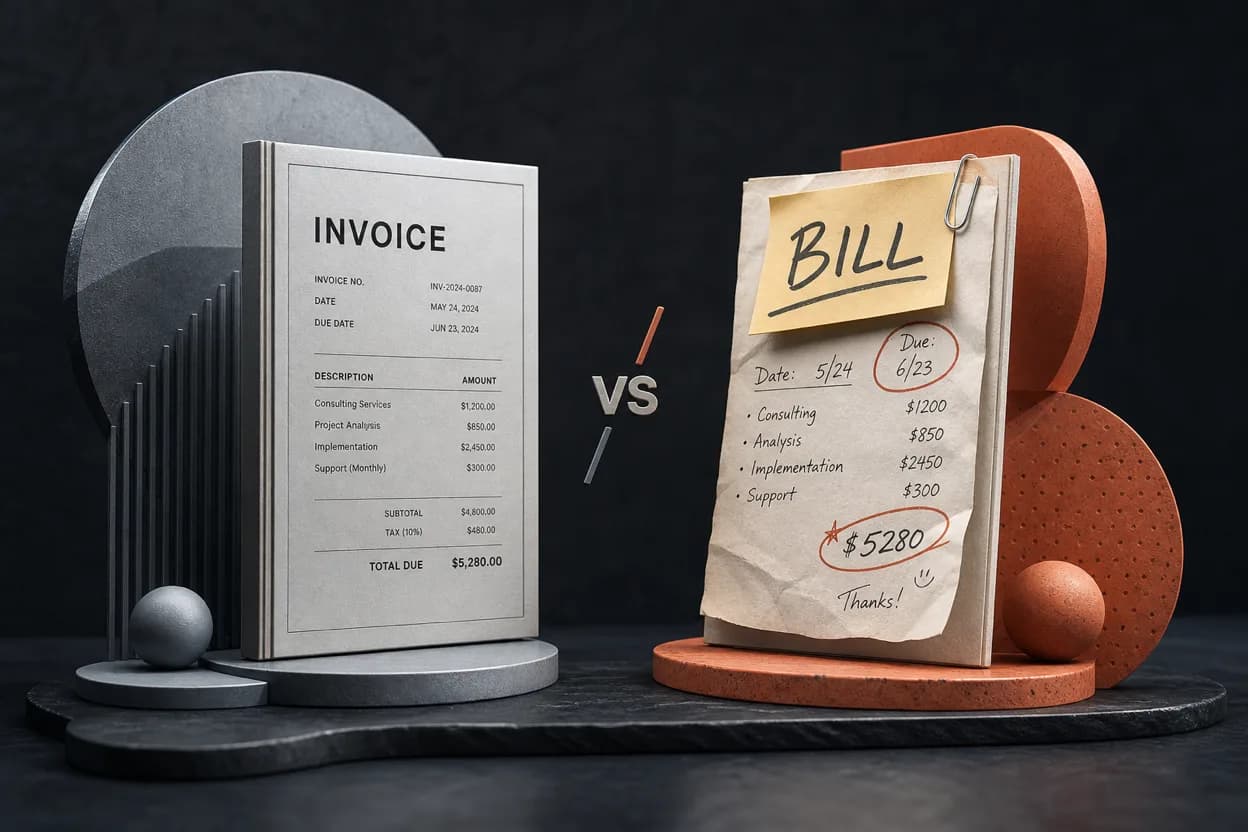
"Invoice" and "bill" often describe the same payment request, especially in casual US English. In day-to-day business language, a freelancer might say "I'll send you the bill" and mean the same document another country calls an invoice.
Operationally, an invoice is the formal payment request you issue with a number, dates, line items, and payment instructions. A bill is broader everyday language — it can mean that same request, a utility statement, a restaurant tab, or an amount your client owes in accounts payable. Invoice vs bill vs receipt is a three-step map: request payment, then confirm payment happened. The distinction matters for record-keeping, client communication, and knowing which document comes next in the sequence. Australian Government invoicing guidance defines an invoice as a document sent to customers to ask them to pay for goods or services, stating how much they owe, when to pay, and how to pay.
Invoice vs bill at a glance
| Question | Invoice | Bill (everyday use) |
|---|---|---|
| Main role | Formal request for payment with commercial detail | Any amount owed; often interchangeable with invoice in speech |
| Typical issuer | Seller, freelancer, or vendor | Seller, utility, lender, or platform |
| Common labels | Invoice, tax invoice | Bill, statement, account |
| Detail level | Usually itemized with number, dates, and terms | Ranges from a one-line total to full itemization |
| In accounts payable | Often filed as the vendor invoice | May appear as bill, voucher, or supplier invoice |
| After payment | May be marked paid; receipt may follow | Often marked paid; receipt or confirmation may follow |
The table describes typical usage, not a universal legal definition. Jurisdiction, industry, and software labels vary. When precision matters — tax, disputes, or audit — use the document type your accountant expects and include the fields local rules require.
Why US English blurs the line
In the United States, "bill" and "invoice" frequently mean the same thing in conversation. A contractor might email "here's your bill for the kitchen remodel" and attach a document titled INVOICE. Accounts payable teams may say they need to "pay the bill" while filing a PDF labeled invoice.
The looseness is linguistic, not structural. The document still needs to identify parties, describe what was sold, state the amount due, and explain how to pay. Whether you call it a bill or an invoice, the client's AP system still needs a number it can match to a payment.
Utility companies, insurers, and subscription platforms often use bill or statement for recurring charges. Professional services firms more often use invoice. The invoice vs statement guide covers the difference between one payment request and a periodic account summary. Neither label alone tells you whether tax lines, purchase-order references, or retention rules apply — the content does.
Invoice vs bill vs receipt
These three words sit at different points in the same transaction.
Quote or estimate
Price and scope before approval
Invoice or bill
Amount now due and how to pay
Payment
Money moves through the agreed rail
Receipt
Confirmation that payment was received
- Invoice / bill — requests payment (before or until paid)
- Receipt — confirms payment happened (after)
A paid invoice or settled bill can support your records, but it is not always interchangeable with a receipt. See invoice vs receipt for when to issue a separate proof of payment.
For documents that appear before billing — quotes, estimates, and proposals — see quote vs invoice vs estimate.
What makes a document an invoice
Regardless of whether you call it a bill in email, a professional invoice should make the commercial request unambiguous. Common elements include:
- Seller name and contact details
- Buyer name and billing details
- Unique invoice number
- Issue date and due date (or clear payment terms)
- Description of goods or services with quantities and prices
- Subtotal, tax, discounts, and total where relevant
- Currency and payment instructions
Australian Government guidance recommends adding a unique invoice number, contact details, and when and how you want customers to pay even where not every field is legally mandatory. Canadian GST/HST rules scale documentary detail by sale amount — for example, CRA input tax credit guidance requires more fields on invoices for supplies of $500 or more to support registrants' claims.
Treat field lists as operational baselines. Confirm requirements for your business and your client's jurisdiction.
When "bill" means something different
Utility and subscription bills
A power, phone, or SaaS bill is usually a recurring statement of charges. It may not look like a project invoice, but it still requests payment by a deadline. You receive it; you pay it; the provider may issue a receipt or show paid status on the next statement.
Restaurant and retail tabs
In many retail or point-of-sale settings, payment happens at the time of the transaction. Australian Government guidance notes that in those cases the receipt may double as the invoice because payment occurs immediately. That is a timing difference, not permission to skip detail on B2B work.
Accounts payable "bills"
Inside a client's finance team, "bill" can mean any vendor document waiting in a queue — including your invoice. Your job is to supply a document their system can ingest: correct legal name, invoice number, PO if required, and rails that match their process.
NeatInvoice issues invoices with numbers, dates, line items, and payment instructions. It does not process payments. Whether your client calls the document a bill or an invoice in conversation, payment still happens through the bank or payment link you provide.
Worked examples
1. Freelance design project (US client)
You finish a $2,400 logo package. You email: "Attached is your bill." The PDF header says INVOICE INV-118. Accounts payable files it as a vendor invoice. The label in speech does not change the document's role: it requests payment by the due date on the page.
2. Monthly office lease (landlord bill)
The landlord sends a rent bill each month with the unit, period, and amount due. It functions like a recurring invoice — no line-item deliverables, but a clear due date and payment method. After you pay, your bank statement and the landlord's receipt (if any) complete the record.
3. GST registrant selling to another business (Canada)
You issue an invoice for $6,000 CAD in taxable services to a GST-registered client. CRA input tax credit documentation expects supplier name, date, total, tax treatment, registration number, buyer name, description, and payment terms on supplies of $500 or more. The client may call it a bill in email; the formal invoice must still carry those fields for their tax claim.
4. Deposit then balance (professional services)
You invoice a $3,000 deposit at kickoff and a $3,000 balance on delivery. Each document is a separate payment request — two invoices in your numbering series, even if the client says "first bill" and "final bill." Partial payment on the first does not close the project total until the second is paid or the original invoice shows a remaining balance.
Invoice vs bill in other English-speaking markets
Labels vary, but the lifecycle is similar.
| Region / context | Common seller term | What buyers often say |
|---|---|---|
| United States (B2B services) | Invoice | Bill, invoice, or vendor paperwork |
| United Kingdom / Australia (B2B) | Invoice or tax invoice | Invoice; utilities may say bill |
| Canada (GST/HST registrants) | Invoice | Invoice or supplier bill in AP |
| Retail / point of sale | Receipt may double as invoice | Bill or receipt at checkout |
When you work across borders, align on currency, tax treatment, and which document number the client's AP system should reference. The word on the PDF matters less than whether the file meets their intake rules.
Record-keeping: one payment request, many names
Your accounting files should tie every payment to a traceable document, regardless of what you called it in conversation.
Keep:
- The issued invoice or bill (original PDF or live-link export)
- Email or portal evidence that it was sent
- Bank or processor confirmation when paid
- Any credit note, void record, or revised invoice if the amount changed
Australian Government guidance recommends keeping invoices as a record of income received and payments made, typically for at least five years for business records. Canadian GST/HST registrants generally keep supporting invoices for six years. Retention rules depend on your jurisdiction — confirm with your accountant rather than assuming one global period.
If a client asks for "the bill" after you already sent an invoice, you usually do not need a second document. Resend the same invoice number with a short note clarifying that it is the payment request they need to approve.
Practical guidance for freelancers
- Use "invoice" on the document even if you say "bill" in casual email — it matches AP language globally.
- Keep numbering consistent — one series for payment requests; do not reuse numbers across quotes and invoices.
- Separate publish, send, and payment — making a live link available is not the same as delivering it or receiving funds.
- Pair the request with proof later — after payment, retain processor confirmations or receipts alongside the invoice. See invoice vs receipt.
- Start from a clear template — the freelancer invoice guide covers fields; the free invoice generator exports a PDF without an account.
Frequently asked questions
Is an invoice the same as a bill?
What is the difference between invoice vs bill vs receipt?
Do I need the word "invoice" on the document?
Is a utility bill an invoice?
How does a bill relate to a quote or estimate?
Sources and related guidance
References used to support this page in . Rules and product details can change; check the linked source for current, jurisdiction-specific information.
- How to invoice by Australian Government
- Input tax credits by Canada Revenue Agency
- GST/HST records to keep by Canada Revenue Agency